Jordi Solà Contel
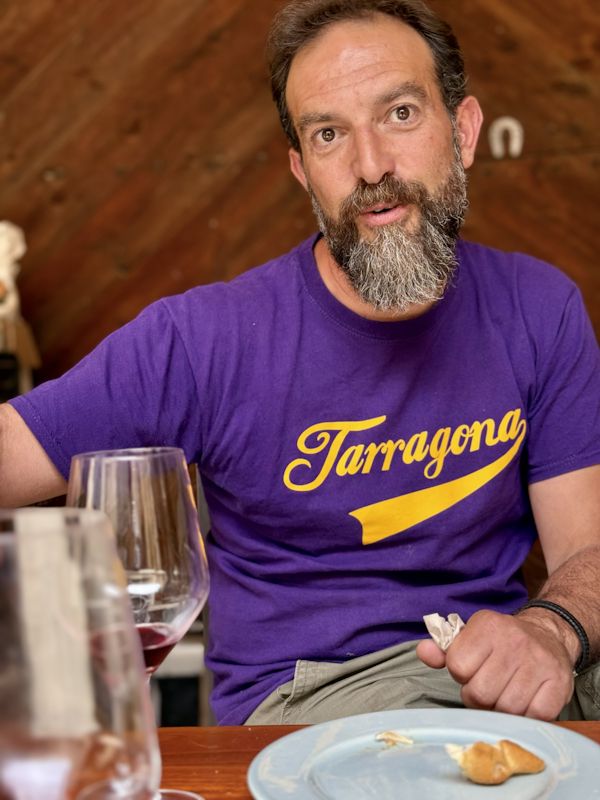
Jordi is Catalan and lives in a former Guardia Civil barracks in Mirambel, a magnificent medieval village where he has established his winery. His vineyards lie in the Valencian and Aragonese Maestrat, at nearly 900 metres above sea level. In that sense, he is an exception within our project, though not entirely: borders are drawn by people, rarely by nature.
Casa Masas ticks every box: vineyards rescued after years of abandonment, a minimalist approach in both the vineyard and the cellar, wines made entirely without additives, joyful living wines, and a winemaker with whom time simply disappears whenever the conversation turns to what truly matters: sharing, the land, the landscape and rural life.
The family home where Jordi lives and works has a remarkable history. Originally a Guardia Civil barracks, it later became a village inn, or posada as they were known. Travellers could sleep, eat, drink, buy everyday essentials and leave their animals in the large courtyard or stables. It was a haven for travellers crossing this isolated mountainous region of the Maestrat.
Born in Barcelona to a family shaped by the rural exodus of the 1950s, Jordi speaks of the gradual depopulation of these mountains as people left for the city. After studying oenology and working in several of Spain's major wine regions, including Priorat, Ribera del Duero, Toro and Castile, as well as spending time in Sicily, he eventually decided to settle here in 2015. Not out of nostalgia, but out of a desire to slow down, find meaning again and build a more coherent way of life.
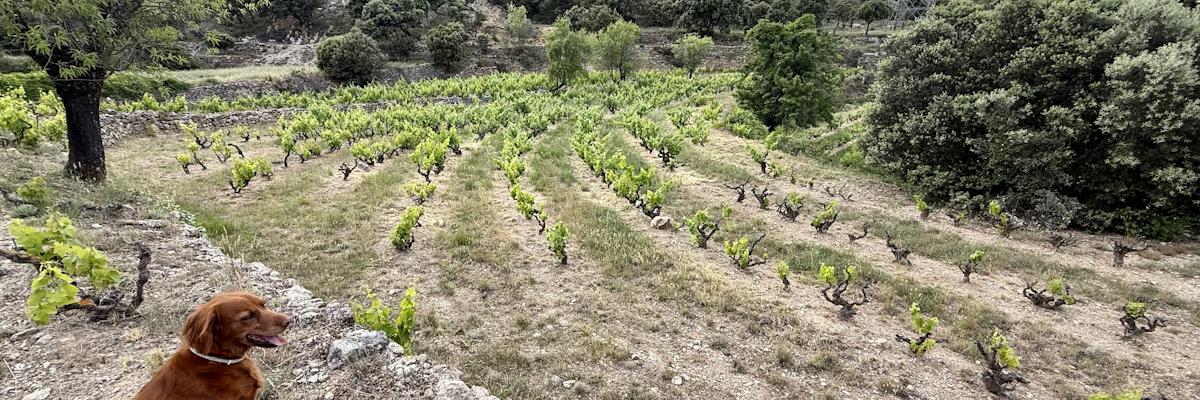
When he arrived, he and his brother opened a small wine bar and delicatessen in the family home, serving local wines, regional products, toasted bread and simple dishes. Before long, however, the vineyard became his main focus. Elderly owners began entrusting him with abandoned plots they could no longer cultivate. Little by little, he recovered around three hectares of scattered old vineyards across the surrounding hills.
The plots are tiny, many planted shortly after phylloxera. Some date back to the 1940s and 1950s. Many are traditional field blends, combining Grenache, Bobal, Bonicaire, Royal, Morenillo and other local varieties that have almost disappeared. Jordi mainly grows Grenache, which dominates around Portell, but also Bobal, once known locally as Tinta Requena, Bonicaire, typical of northern Castellón, and Royal, locally called Rojal or Rotllofa. Some vineyards also contain Morenillo and other ancient varieties that are difficult to identify today. Jordi sees this diversity as the hallmark of traditional peasant viticulture, where resilience mattered more than uniformity.
The landscape itself tells a story of decline. Once largely devoted to farming and sheep grazing, much of the region has now been abandoned or converted to cattle farming, which is easier to manage. Many of the remaining vineyards survived only because a few families continued making wine for their own consumption.
In 2019, Jordi officially registered his small 40-square-metre winery and began selling his wines commercially. Production remains tiny, ranging from 2,500 to 4,800 bottles depending on the vintage. Recent droughts have significantly reduced yields, forcing him in some years to purchase small quantities of grapes from Bajo Aragón or Matarraña to complete production.
His philosophy of natural wine is both uncompromising and pragmatic. After his first vintages, made with sulphites and egg-white fining, he decided in 2014 to stop adding anything to his wines. No added yeasts, no additives and virtually no filtration. The only filtration he uses is an extremely coarse one, intended merely to prevent insects or other debris from entering the bottle rather than to alter the wine itself. Tartrate stabilisation occurs naturally thanks to the intense cold of the Aragonese winters.
Today the bar has closed. Running it alongside the vineyard became impossible, especially in a region where finding staff is increasingly difficult. Instead, Jordi now welcomes visitors for tastings accompanied by meals prepared by reservation. More than a technical cellar visit, he offers a genuine experience centred on wine, local food, stories and time shared together.
When asked about the future, Jordi speaks neither of growth nor expansion. His only ambition is to preserve these old vineyards, continue working at his own pace and help keep alive an agricultural landscape that is slowly disappearing.