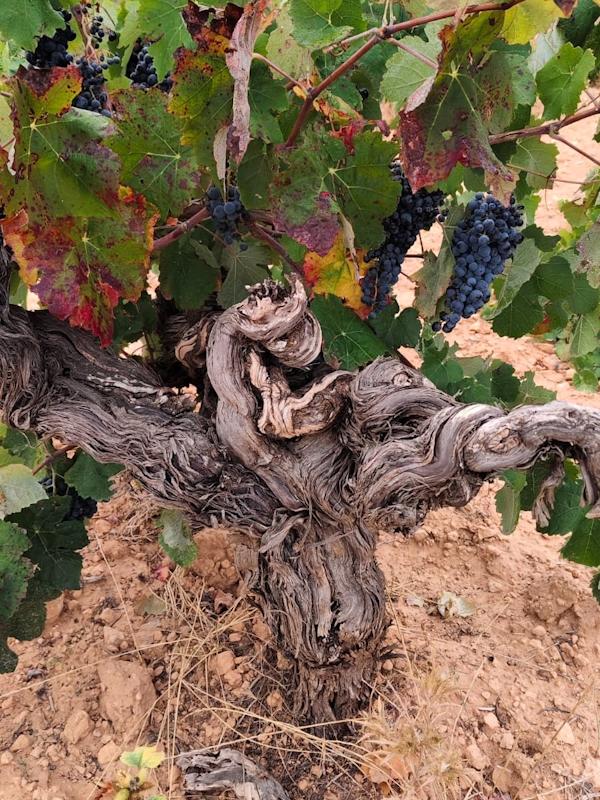
For a long time, people tried to explain Bobal through crossings, supposed kinships, uncertain genealogies. It was linked to Terret noir, given Mediterranean cousins, sent to France under the name Carignan d'Espagne. All theories born before DNA, attempts to order the living world with the tools of another era.
Today we know something simpler and stronger: Bobal is an indigenous variety, deeply rooted in the lands of Utiel-Requena and the Valencian Country. Adapted to dry climates, altitudes and poor soils. A personality that needs no invented genealogy to exist. For decades, Bobal was the grape of volume. Abundant production, intense colour, good acidity. Ideal for cooperatives, blends, industrial rosés, bulk wine. And so it inherited a reputation for rusticity: harsh, astringent, inelegant. But the problem was not the grape. The problem was the way people looked at it. Bobal is vigorous, yes. It has thick skin, marked tannins, naturally high acidity. If you force it, it gives you hardness. If you listen to it, it gives you truth. With low yields, old vines and respectful winemaking, Bobal reveals another face: freshness, clean fruit, tension, and an ageing potential long denied to it.
This is where the work of winegrowers who chose to listen to the vine rather than dominate it comes in. Verónica Romero and her sensitive, precise approach. Bodegas Pigar, recovering lost Bobals. Cueva de Mariano Taberner, where Bobal becomes soft and oxidative. Sexto Elemento, with twenty-four months in oak barrels. The Ferrer Gallego brothers and their Endemic project, with great oenological ambitions. And Pablo from Bodega Escuadra, an architect who thinks about wine with mathematics.
They all share one conviction: do not disguise the Bobal. Let it be. And that is perhaps its great lesson. This grape does not seek to please everyone. It does not produce made-up wines. It produces wines that reflect the place, the vintage, and the hand that works it. You always come back to the terroir.
Rediscovering Bobal is not following a trend. It is reconciling with a variety that was always there, waiting to be looked at with respect. That too is natural wine.
To place Bobal among the other varieties of the Valencian Country, see the inventory of Valencian grapes.