It is impossible to talk about natural wine without touching on one of its most contentious topics: sulfites. Sulfur is an indispensable, even essential element of life on earth. Both in the vineyard and in the cellar, it has been used since Roman times, when its virtues were already well known. In wine, sulfur dioxide (SO₂) can be used during vinification to eliminate micro-organisms that are not involved in fermentation, and also at bottling to improve preservation. Sulfites form when sulfur dioxide comes into contact with wine. The quality and origin of the sulfur matters: it can be volcanic, the yellow powder, or derived from the petrochemical industry.
Over the past century, industrial processes have become widespread, and chemistry is increasingly present in food processing. Sulfites have antioxidant and antibacterial properties, which is why they are used as preservatives and found in many food products. The compounds in the E220 range (E220 to E228) all belong to the sulfite family. All wines bottled since 8 December 2023 must indicate on the label the list of ingredients used and a nutritional table, or a QR code linking to a web page with this information.
Sulfites are accused of causing headaches, though pesticides and fungicides used in the vineyard are also thought to contribute to hangovers. Worse, some people develop a sulfite intolerance, similar to gluten intolerance caused by selected wheat varieties.
In the 1960s, a handful of visionary French winegrowers set themselves the goal of making wines without any additives, starting with the most difficult to eliminate: sulfur. The best known are Jules Chauvet in Beaujolais and Pierre Auvernoi in Jura. A community in search of healthy, living, pure wines. Here in the Marina Alta I know several winegrowers who produce natural wines but still add small amounts of sulfites for personal reasons, perhaps for reassurance. A living wine can travel through the years without problems, as Roman amphorae attest, provided it is kept in good conditions, ideally below 25°C to avoid refermentation.
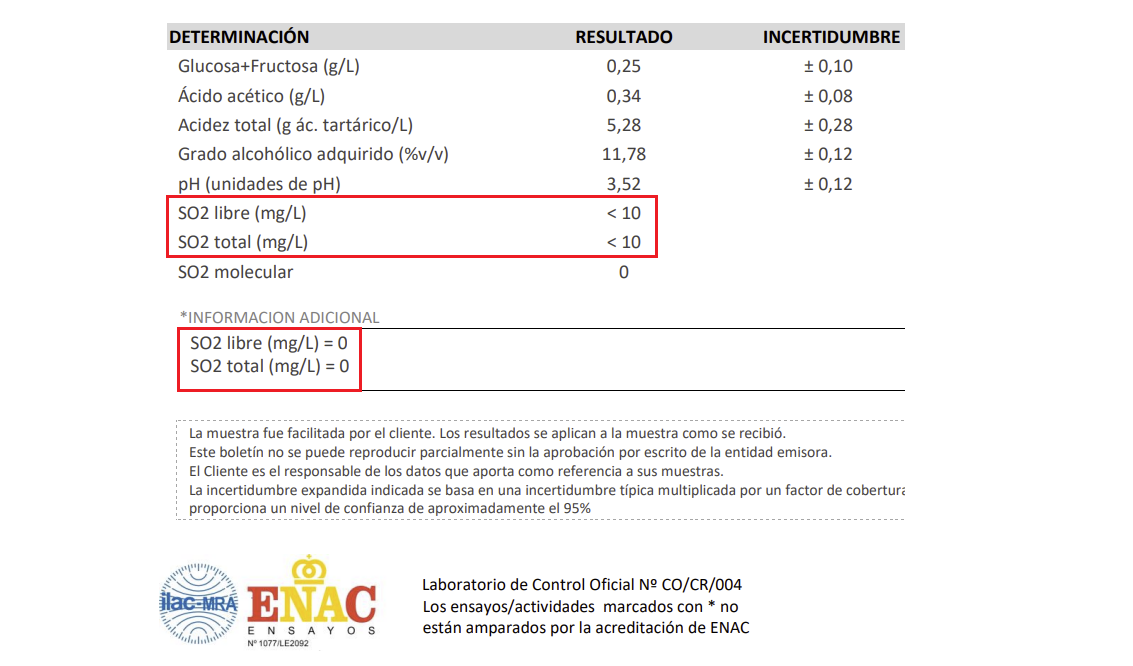
All wines contain sulfites, either naturally in minute quantities of less than 10 mg per litre, or added in amounts defined for each category. Conventional wines contain between 150 and 200 mg per litre, up to 400 mg for sweet wines. Organic certification allows between 100 and 150 mg per litre, and between 70 and 80 mg for Demeter-certified wine. A natural wine contains less than 20 mg per litre. The French association Vin Méthode Nature holds two certifications: one for wines with no added sulfites, and one for wines with less than 30 mg per litre.
That said, it is possible to find on the market wines with organic certification that contain no added sulfites. There are also wines with laboratory analyses showing 0 mg. These are known as double-zero wines: nothing in the vineyard, nothing in the winemaking. Easier said than done.