Fondillon is the most recognised and internationally celebrated wine of Alicante for centuries, or so we have been told over the years. This story deserves to be questioned. While many sources affirm and ratify this, other researchers argue that this first wine was not Fondillon at all but a sweet red wine. It seems that the first Alicante wine was produced in the 15th century in the "Horta Alicantina", the market garden plain of Alicante, known as the wine of Allegant. Many sources consider it or have called it, for reasons unknown, Fondillon wine. That said, one must bear in mind that Alicante wine is not Fondillon, even if Fondillon is a wine from Alicante.
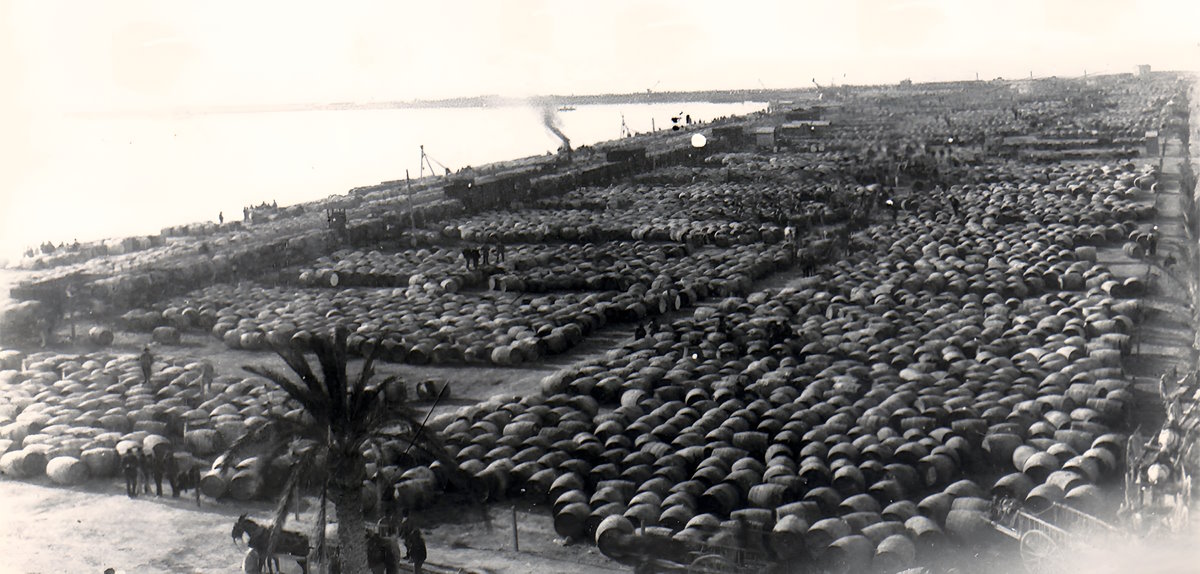
The success of the wine from the Alicante plain was such that grape growing spread during the 16th and 17th centuries to neighbouring towns and the regions of the Medio and Alt Vinalopó, closely connected to the Valencian bourgeoisie. At that time, two different varieties of Fondillon coexisted: that of the Horta d'Alacant and that of the neighbouring counties, both made from the Mourvèdre grape (Monastrell in Castilian, Monestrell in Valencian), but with different ageing. Some consider that the first, from the Horta, was Fondillon, though it is not clear whether its production conformed to what defines Fondillon today.
What is certain is that wine production was very important in the lands that we now consider the province of Alicante. A significant fact reflecting the weight of the sector in the economy is that Fernando the Catholic signed a privilege on 18 January 1510 prohibiting wines from other cities from entering Alicante until local production was consumed. He created the Council for the Prohibition of Foreign Wines, which also served to regulate the origin and quality of Alicante wine. This was the first viticultural designation of origin.
On the whole, experts in the field believe that neither of the two Alicante red wines, neither that of the Horta nor those of the neighbouring regions, can be called Fondillon. We cannot therefore speak of the origin of Fondillon. Let us hope we will one day be able to say who, when and how made that first bottle. It was probably the result of the accumulation of barrel dregs mixed with younger wines. So there is no possibility that the bottles of this sweet wine that travelled the world were Fondillon. You see, the matter is complicated.
What seems indisputable is that the sweet, generous red wine of Alicante was the most celebrated, appreciated and consumed by the European elite. It is said to have been the favourite of the Sun King and of Elizabeth I of England. The Duke of Saint-Simon, official chronicler of the court, recounts that Louis XIV of France would dip biscuits into it. That is why it was nicknamed the "wine of kings". As an example, here is a reference from The Count of Monte Cristo by Alexandre Dumas:
"Sit down," said Monte Cristo; "I really don't know what I'm thinking... I have kept you standing for a quarter of an hour."
"That is nothing, Count..." The old man took an armchair and sat down.
"Now," said the Count, "would you like something to drink? A glass of Jerez, Porto, Alicante?"
"Alicante, since you insist; it is my favourite wine."
We must move beyond the question of origins to approach what will bring us to the present. At the end of the 19th century, there were around 4,000 wine establishments in the province. With phylloxera, changes in the world and the Spanish economy, and other conjunctural factors, vine cultivation declined dramatically. It is estimated that at the beginning of the 20th century, before the Spanish Civil War, fewer than 100 hectares remained dedicated to Mourvèdre.
Contrary to the idyllic version of a triumphant and popular wine, everything suggests that Fondillon was a wine of limited production, destined for demanding minorities. An elitist wine that could not escape the hard times either and was close to disappearing.
A renaissance came in the mid-20th century, attributed by some sources to two important Alicante wine producers: Salvador Poveda and Primitivo Quiles. In the 1960s and 70s, they bought back, recovered and restored some old barrels to produce Fondillon once again.
Today this wine has returned in force, meeting great success, curiously among the higher purchasing power classes of the cooler regions of Eastern Europe. The noble wine of Alicante is finally recognised and valued as it deserves.
What is Fondillon?
The DO (Designation of Origin) Vinos Alicante devotes an entire manual to this most emblematic wine. The first step in obtaining it is to leave the Mourvèdre grapes to ripen fully under the sun. By leaving them longer than would be needed for any other wine, the grapes gain extra degrees of sugar, which gives the wine its characteristic sweetness. The purists insist that the only variety for making Fondillon is Mourvèdre, while others produce it from different grape varieties and are excluded from the Designation of Origin.
The sugar provided by the sun and the arid soil in which the grapes are grown gives Fondillon its second characteristic: a minimum of 16 degrees of natural alcohol. The word "natural" must be emphasised, because this high degree is obtained solely and exclusively from the grape's own sugar, which is not the case for other fortified wines such as Sherry. Sherry's alcohol content is added. This singularity is one of the elements that distinguish the two most celebrated sweet wines of the Iberian Peninsula.
How is it produced?
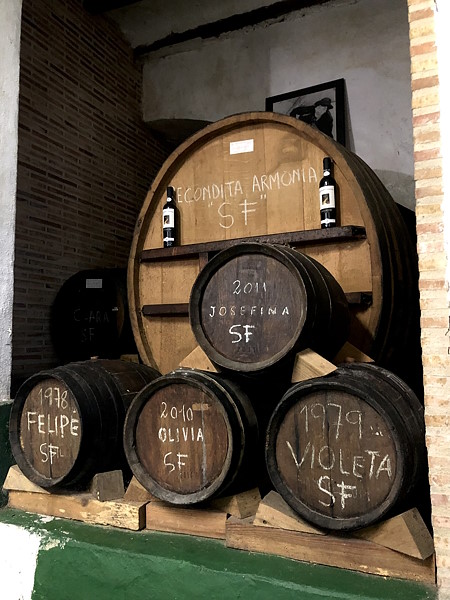
Winegrowers harvest overripe grapes to obtain more sugar and the particular dried-fruit finish of Fondillon. The must is introduced into large barrels where the wine will age for at least five years, after which a decisive tasting determines whether it is suitable for Fondillon. If so, it will remain there for at least another five years, generally between 20 and 25 years in total.
The barrel containing the original wine, the oldest, is placed on the ground, and barrels containing later vintages are stacked above it. It must remain full. As the wine rests, day after day, month after month and year after year, voids appear caused by the oxidative process of the wine and by the "saca", the extraction of wine for bottling. To complete the original barrel, the younger wines from the barrels above are used. This is the solera! The result is that the most mature wine bonds with the younger ones, which must be at least five years old, sharing all its wisdom with them. A magic is born that transforms grape juice into a rancio wine, with flavours of spices and ripe fruit, an intense amber hue, that reaches the market in the peculiar and characteristic Fondillon bottle.
When you discover the bottle, round, generous, welcoming as a mother's embrace, you already know you are about to drink a special wine. The question is: how could you not come back for more?
Blog Las Provincias · Blog Villa Viniteca · Casa Torre Juana · Cata del Vino · D.O. Alicante Regulatory Council · La Vanguardia · Diario de Cádiz · Fondillón Luis XIV · Fundéu RAE · Gastropass · Mark O'Neill · MG Wines Group · Primitivo Quiles · RAE · Revista Origen · Universidad Autónoma de Madrid · Vicent Torres Bañuls · Wikipedia