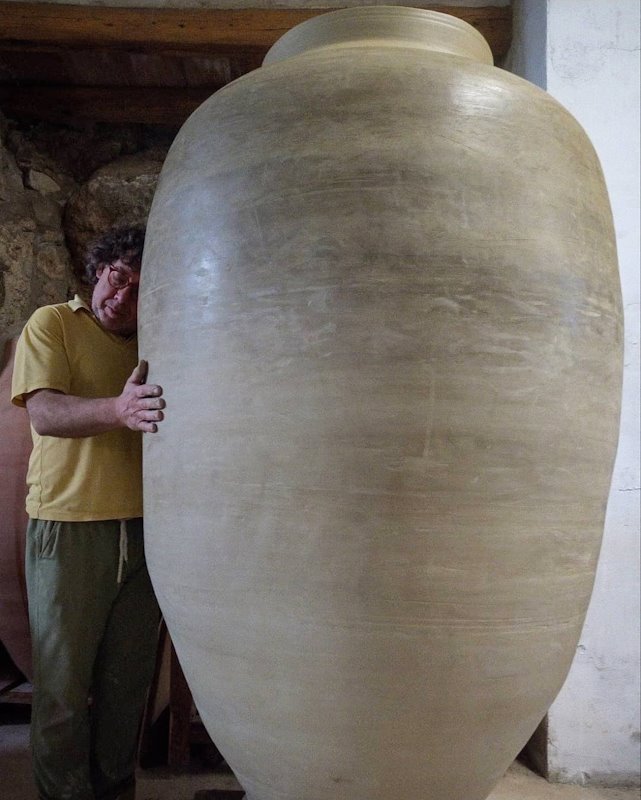
Terracotta jars first appeared over 6,000 years ago, notably in Georgia, the cradle of viticulture, where these vessels are called "kvevris". Buried entirely, sometimes in the middle of the vineyards, to maintain a constant temperature, kvevris play an essential role in the fermentation and ageing of traditional Georgian wines, often produced with skin-contact maceration to create unique amber wines. Their use spread throughout the Mediterranean basin before being gradually replaced by wooden barrels and metal tanks. In Roman times, the jars used for ageing were called "dolias". Today, their use is returning, driven by winegrowers keen to approach natural methods and express their terroir.
The distinguishing feature of these vessels is their material: terracotta. It is a porous material that allows micro-oxygenation of the wine, like wood, but without imposing its flavour. This neutrality is a major asset for natural wines, as it allows the pure expression of the grape variety. The size of the amphora influences the degree of micro-oxygenation: the larger it is, the lower the surface-to-volume ratio, limiting exposure to oxygen. Vitrification can limit or eliminate micro-oxygenation. It can be achieved in several ways: glazing, high-temperature firing, application of wax or resin, or manual polishing with ash or metal oxides.
Another advantage: terracotta offers excellent thermal inertia, ideal for maintaining a stable temperature during fermentation. The ovoid shape also promotes natural clarification, reducing the need for external intervention. Each piece is unique, hand-shaped from carefully selected clays. The manufacturing process is long and demanding: shaping, drying, firing. But it is this artisanal precision that guarantees quality and durability. They are made in all shapes, more or less ovoid, which also influences the taste of the wine. The quality and preparation of the clay before firing, and the firing temperature, allow precise control of the level of micro-oxygenation. For example, amphorae from the Valencian Country are known to be denser, and therefore less porous, than Italian or Georgian ones.
Many natural winegrowers have adopted terracotta, convinced it enhances their wines. Cuvées aged in amphora are often distinguished by their aromatic purity and silky texture. These wines are the reflection of a philosophy: respect for the grape, the terroir and time. The return of the amphora is much more than a passing trend; it is a desire to reconnect with ancient practices while innovating with contemporary mastery.
From Pego, Marina Alta, a region rich in ancestral wine history, I would like to close by mentioning the Museu de la Mar in Dénia. This ancient Roman port houses a magnificent collection of amphorae, testament to their essential role in ancient trade, whether for wine, olive oil or garum, an emblematic fish sauce of Roman cuisine. A must for lovers of Mediterranean history and culture.